Umami and Satiety: Why Savory Foods Make You Feel Full
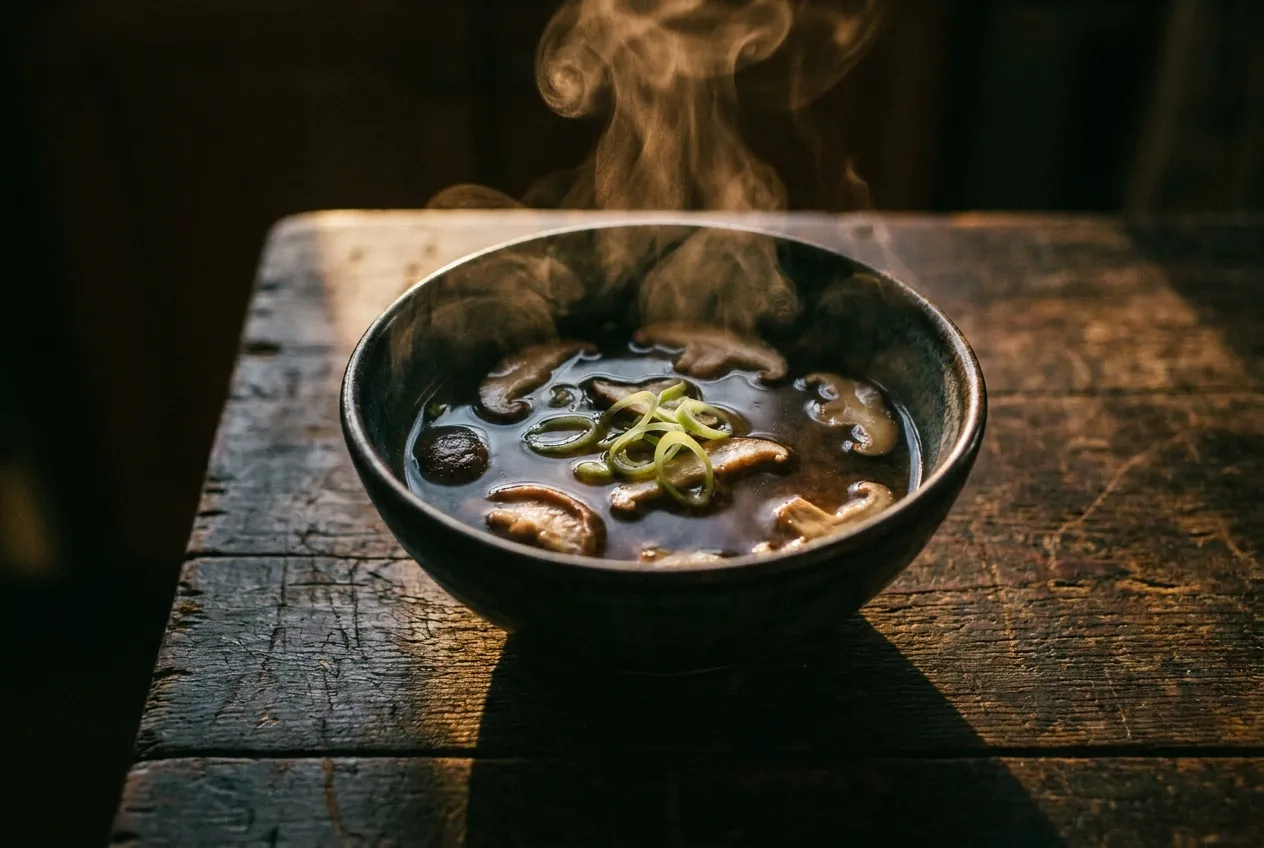
Umami is the reason a bowl of miso soup, a slow-simmered broth, or a tomato sauce that has cooked all afternoon leaves you feeling settled in a way a handful of crackers never does. It is the savory, mouth-filling, faintly meaty taste — the so-called fifth taste, alongside sweet, sour, salty, and bitter — and it does more than make food pleasant. Umami appears to be one of the signals your body uses to register that real nourishment has arrived.
That matters if you have ever finished a large meal and still felt unsatisfied, or found yourself grazing an hour later without genuine hunger. Fullness is not only a question of volume in the stomach. It is a conversation between what you taste, what reaches your gut, and how your brain reads those messages. Savory foods seem to speak that language fluently.
This article covers what umami actually is, the honest state of the science on how it influences satiety, which everyday foods carry the most of it, and a fair look at the long-running fear over MSG. The evidence is real but more modest than the headlines suggest — and understanding it can quietly change how you build a meal.
What is umami?
Umami is the fifth basic taste. The word is Japanese, roughly meaning “pleasant savory taste,” and it was named in 1908 by the chemist Kikunae Ikeda, who isolated the compound responsible from a broth made with kombu (kelp). That compound was glutamate — an amino acid — in its free, unbound form.
For most of the last century, umami was treated as a curiosity rather than a true taste. That changed when researchers identified dedicated taste receptors for it on the tongue in the early 2000s, chiefly the T1R1/T1R3 receptor pair, along with certain glutamate-sensing receptors. Umami now sits on solid biological ground: a distinct sensation with its own machinery, not merely a variation on saltiness.
Two families of compounds create it. The first is free glutamate, abundant in tomatoes, aged cheese, seaweed, and fermented foods. The second is a set of ribonucleotides — inosinate (from meat and fish) and guanylate (from mushrooms). On their own each tastes savory; together they produce a striking synergy, multiplying the intensity of umami far beyond what either delivers alone. This is why dashi (kombu plus bonito) or a tomato-and-parmesan sauce tastes so deeply savory: two umami sources amplifying each other.
How umami signals fullness (the science)
Here is the key idea: umami is, in essence, the taste of protein. Glutamate is one of the most abundant amino acids in protein-rich foods, and its free form rises as food is aged, cured, fermented, ripened, or slow-cooked — all processes that break proteins down into loose amino acids. A savory taste, then, is a sensory flag that protein and amino acids are present.
That flag is worth paying attention to, because protein is the most satiating of the three macronutrients. It stimulates the release of gut hormones associated with fullness — cholecystokinin (CCK) and glucagon-like peptide-1 (GLP-1) — and it slows the rate at which the stomach empties. These are well-established mechanisms by which a protein-containing meal keeps hunger quiet longer than an equal number of calories from refined carbohydrate.
One influential idea, the protein leverage hypothesis, proposes that humans eat to reach a protein target: when a diet is diluted with fat and refined carbohydrate and runs low in protein, we tend to overeat total calories chasing the protein we need. Within that framework, a reliable taste signal for protein could, in principle, help the body register adequacy sooner. It remains a hypothesis, but a serious and much-discussed one.
There is also a second sensing site beyond the tongue. The stomach and intestine carry versions of the same taste-receptor machinery, and in animal studies glutamate in the gut activates fibers of the vagus nerve — the main line reporting the state of your digestive tract back to the brain. That is the deeper plumbing behind gut–vagus satiety signaling: what you taste and what reaches your gut both feed the same conversation about whether you have had enough.
Scientific Receipt — Umami compounds (glutamate plus 5’-ribonucleotides) act on savory-taste and gut chemosensors that feed into appetite and satiety signaling. In a controlled preload trial, adding monosodium glutamate and inosine monophosphate to a low-energy soup produced a biphasic effect — heightening appetite while the soup was eaten yet enhancing fullness afterward and reducing later food intake — an effect measured in a single small laboratory study rather than across long-term eating. Masic & Yeomans, American Journal of Clinical Nutrition, 2014.
That biphasic result captures why the honest verdict is nuanced. The human evidence is genuinely mixed. Some preload studies, in which people drink a savory MSG-enriched soup before a meal, find reduced intake at the meal that follows, sometimes most clearly in people prone to overeating. Others find that umami mainly makes food more appealing and can increase how much of a savory dish people enjoy in the moment. A few find no meaningful effect on total calories at all. There is no good evidence that adding umami causes weight loss.
The fair reading is this: savory taste plausibly supports satiety signaling and, just as importantly, meal satisfaction — but it is a modest lever, not a switch, and it works alongside protein and fiber rather than in place of them. The mechanism of using savory taste to help complete the body’s satiety signal is the basis of the Umami Completion Signaling protocol, and its promise is precisely as measured as the science above: helpful, real, and worth using with clear eyes.
Umami-rich foods
You do not need additives to eat more umami. It is concentrated in a wide range of whole and traditionally prepared foods:
- Tomatoes — especially cooked, roasted, sun-dried, or as paste, where glutamate is most concentrated
- Mushrooms — particularly dried shiitake, which are dense in guanylate
- Aged cheeses — parmesan, pecorino, aged cheddar, gruyère
- Fermented soy — miso, soy sauce, tamari
- Sea vegetables — kombu (kelp), nori, and dashi, the kombu-and-bonito stock at the heart of Japanese cooking
- Cured and preserved fish and meats — anchovies, fish sauce, bonito flakes, prosciutto, aged ham
- Bone broth and long-simmered stocks, where slow heat frees glutamate from collagen and meat
- Other ferments — kimchi, sauerkraut, and fermented foods broadly, which develop savoriness as they age
The practical trick is synergy. Pair a glutamate source (tomato, cheese, kombu) with a ribonucleotide source (mushroom, cured meat, bonito) and the perceived savoriness multiplies — often letting you use less salt for the same depth of flavor. Building meals around these combinations, rather than around processed flavor shortcuts, is the core discipline behind the Sovereign Kitchen protocol.
Is MSG actually bad for you?
Monosodium glutamate is the sodium salt of glutamate — the identical molecule that makes a tomato, a wedge of parmesan, or a spoon of miso taste savory. Your digestive system does not distinguish glutamate that arrives as MSG from the glutamate naturally present in those foods; it is metabolized the same way. This is the single most important fact in the entire MSG debate, and it is routinely left out.
The fear traces to a 1968 letter to a medical journal describing vague symptoms after Chinese restaurant meals, which coined the phrase “Chinese restaurant syndrome” and set off decades of anxiety. The trouble is that the story rested on anecdote, and anecdote has not survived controlled testing.
Scientific Receipt — Dietary glutamate from MSG is handled by the body much like the glutamate naturally present in protein-rich and fermented foods. A comprehensive review of the clinical literature reported that food-safety regulators classify MSG as generally recognized as safe and that controlled human trials have not consistently reproduced the symptoms long attributed to it — while noting that most alarming findings come from animal studies using doses far beyond ordinary dietary intake. Zanfirescu et al., Comprehensive Reviews in Food Science and Food Safety, 2019.
Double-blind, placebo-controlled trials have generally failed to reproduce a consistent symptom pattern at the amounts people actually eat. Occasional responses appear only with very large doses taken without food, and even then inconsistently. The U.S. Food and Drug Administration lists MSG as generally recognized as safe, and in 2018 the International Headache Society removed MSG from its list of headache triggers.
Two fair caveats keep this honest. MSG does contain sodium — roughly a third of the sodium of table salt by weight — so it counts toward your sodium intake, though because a little delivers a lot of savoriness it can be used to reduce total sodium in a dish. And if you personally and reliably feel unwell after it, honoring your own experience is reasonable. The point is not that no individual ever reacts to anything; it is that the broad, population-level fear of MSG is not supported by the evidence.
How to use umami to eat more mindfully
The goal is not to game your appetite. It is to build meals that leave you genuinely satisfied, so you are less driven to graze on autopilot afterward. A few practical, evidence-aware moves:
- Lead with a savory first course. A small bowl of broth or miso soup before the main meal is a low-calorie way to introduce umami and slow the pace of eating.
- Pair umami with protein and fiber. Savory taste is a cue; protein and fiber do the real satiety work. Anchor umami to them rather than to refined carbohydrate alone.
- Cook to build umami. Roast tomatoes, brown mushrooms and meat, simmer a parmesan rind into a sauce, or add a splash of soy or fish sauce. Concentrating savoriness through cooking often lets you use less salt and fewer processed flavor shortcuts.
- Slow down and taste. Satiety signals lag behind the food itself. Eating slowly gives the gut–brain conversation time to catch up before you have overshot.
- Treat it as a satisfaction strategy, not a weight-loss hack. The honest benefit of umami is a more contented meal, and contentment is a legitimate goal in its own right.
If you want a simple, guided place to begin steadying your relationship with food and stress rather than assembling a plan yourself, start with the free Vagal Reset guide.
This article is educational and is not medical or dietary advice. Umami and savory foods are a tool for building more satisfying meals — not a treatment for any condition and not a weight-loss intervention. If you manage diabetes, kidney disease, high blood pressure, an eating disorder, or any condition affected by diet or sodium, consult a qualified clinician or registered dietitian before making changes.
The steadier your nervous system, the easier mindful, unhurried eating becomes; if that is where you want to begin, the free guided reset is the simplest first step.
Frequently asked questions
- Does umami make you feel full?
- Umami itself carries almost no calories, but savory taste appears to support fullness by signaling that protein has arrived and by feeding into gut satiety pathways. The human evidence is real but modest and mixed, so treat umami as one contributor to a satisfying meal rather than an appetite switch.
- What foods are high in umami?
- The richest everyday sources are ripe and cooked tomatoes, mushrooms (especially dried shiitake), aged cheeses like parmesan, fermented soy such as miso and soy sauce, seaweed and dashi, cured meats and anchovies, and long-simmered bone broth. Fermenting, aging, curing, and slow cooking all raise a food's umami.
- Is MSG bad for you?
- For the general population, no. MSG is the sodium salt of glutamate, the same molecule that makes parmesan and tomatoes taste savory, and regulators classify it as generally safe. The symptoms once blamed on it have not held up in controlled trials, though it does contribute some sodium.
- How can I feel fuller without eating more?
- Lead with a savory, protein-containing first course such as broth or miso soup, pair umami with protein and fiber rather than refined carbs, cook to build savoriness so you need less salt, and eat slowly enough for satiety signals to register.